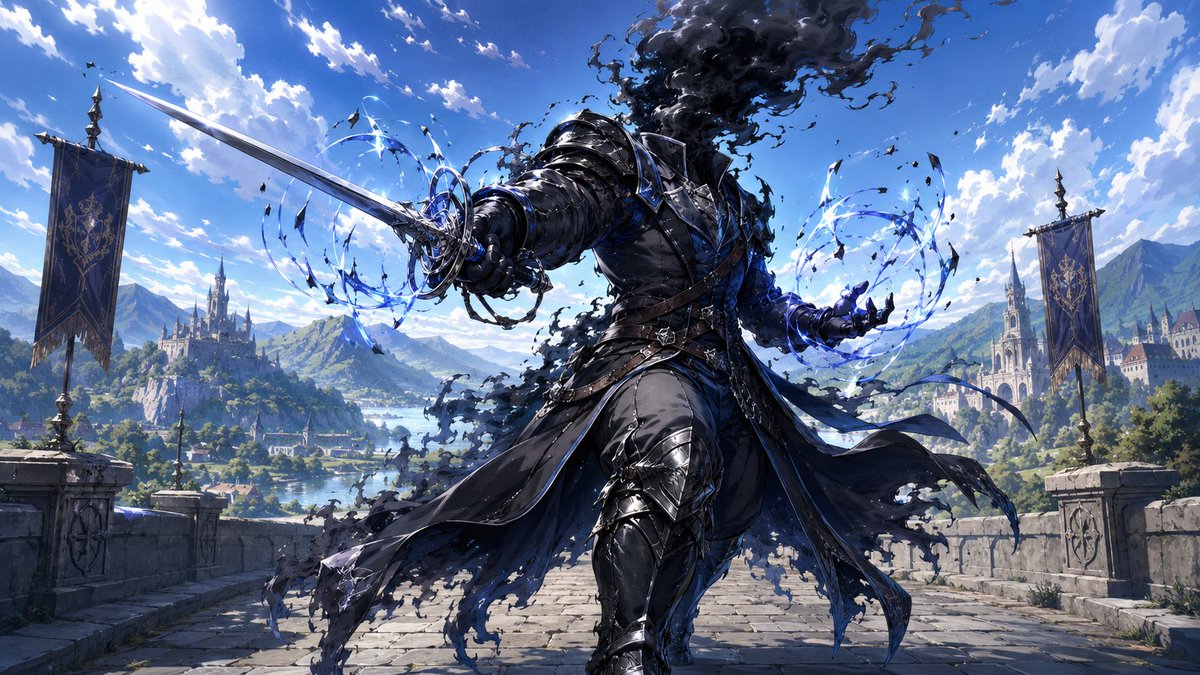
@Image1 = main character identity reference
{SUBCLASS} = (blank = let the image decide; or name one from the
allowed list)
{WEAPON} = (blank = default to a sword — or a bow if the
subclass is Arcane Archer; or name any specific
weapon to lock it, e.g. greatsword, warhammer,
halberd, rapier, longbow, dual axes)
{ENVIRONMENT} = (blank = random from the list; or name a specific
setting/scene)
Create a highly detailed epic fantasy medieval cinematic
illustration set in the world of Dungeons & Dragons, depicting
the character from @Image1 reimagined as a FIGHTER, striking a
dynamic, badass heroic pose.
— IDENTITY LOCK (PERSON, NOT CLOTHES, NOT A FROZEN HEADSHOT) —
ABSOLUTE HEAD/FACE RULE (READ FIRST — OVERRIDES EVERYTHING
BELOW): Before applying any other identity instruction, check
@Image1's head and face. If the source has ANY of the following
— no visible head at all, a smoke/shadow/void where the head
would be, a mask, a helm, a veil, a hood that conceals the face,
bandages, a covered or obscured face, or any face-covering
accessory — then that exact trait is PERMANENT, IDENTITY-
DEFINING, and PRESERVED EXACTLY as the source has it. Do NOT
remove it. Do NOT replace it with a bare face. Do NOT "reveal"
the face behind it. Do NOT invent a head where there is none. A
masked character stays masked (same mask); a headless/smoke-
headed character stays headless/smoke-headed; a helmed character
keeps the helm. The "freshly-posed face" instruction in the next
paragraph DOES NOT APPLY to a covered or absent head — you may
re-angle the head/mask/helm with the body's motion, but the
covering or absence itself is never undone. This rule wins over
every pose, presentation, transformation, and camera instruction
in this prompt.
Carefully analyze @Image1 and preserve the character's CORE
IDENTITY — but NOT their original outfit, and NOT the original
head angle, gaze, or expression. Preserve:
- facial LIKENESS / identity: ONLY IF the source face is visible
and uncovered (if it is covered or absent, the ABSOLUTE rule
above governs and this bullet does not override it). For a
visible face: the same recognizable face — bone structure, eye
shape and color, distinctive features — so it is unmistakably
the SAME PERSON. The head angle, gaze direction, and facial
expression are NOT fixed: render the face from whatever new
angle and with whatever expression the rolled POSE and action
call for. Think of it as the same actor filmed in a new shot —
clearly them, freshly posed — NOT their original headshot
pasted onto a new body. (Again: this freshly-posed-face license
applies ONLY to an already-visible, uncovered face; it NEVER
licenses uncovering a mask/helm/veil or supplying a missing
head.)
- any MASK, helm, veil, face-covering, or head-absence is itself
a preserved identity feature per the ABSOLUTE rule above — kept
exactly, re-posed with the body but never removed or revealed
- hair color, hairstyle silhouette (the style may move/flow with
the action; the color and general look stay)
- body type and proportions
- distinctive NON-CLOTHING features: horns, markings, tattoos,
beast/fiendish/eldritch traits, auras, scars, glowing effects
- the overall COLOR PALETTE of the character
- OUTFIT INSPIRATION — the source outfit's design DNA: its
silhouette and garment type (dress, armor, robe, coat, gown,
leathers, etc.), dominant patterns and motifs (patchwork,
smoke effects, stripes, frills, layered fabric, leather
straps, fur trim, etc.), ornamentation character, signature
accessories or symbols, and the overall design language of
what they're wearing — this is preserved AS IDENTITY and
flows through into the new class attire below
- personality vibe and overall mood/energy
— TRANSFORMATION (REIMAGINE FOR ROLE) —
IMPORTANT: Do not preserve clothing literally. Instead, reimagine
the character into their class-appropriate form, with custom
details inspired by their original design.
Reimagine @Image1 as a fighter version of themselves.
Their fighter attire should feel genuine to the class,
high-fantasy, and personality-driven: well-fitted battle armor (plate, half-plate, mail, or leather as appropriate), weapon harnesses and sword belts, heraldic tabards or surcoats, gauntlets and pauldrons, buckled greaves and reinforced boots, practical battle-ready trim, martial bearing in the cut, and custom details
inspired by the original design. The preserved OUTFIT INSPIRATION
from the identity section above (silhouette, patterns, motifs,
colors, ornamentation, signature accessories) flows through into
the new attire — a patchwork source produces patchwork fighter
gear; a dress source produces a fighter's dress; an armored
source stays armored; the source's design language carries
forward into the role.
Do not turn them into a generic fighter. They must still
clearly read as the same character. Preserved anatomical features
(wings, tail, horns, tentacles, etc.) are kept and the reimagined
attire is built around them.
— CLASS (LOCKED) —
The character's class is FIGHTER. This is fixed. Do not change,
hybridize, or substitute the class.
— SUBCLASS (USER-LOCKED OR REASONED SELECTION) —
If {SUBCLASS} is provided, use that exact Martial Archetype from
the list below — do not override it, do not second-guess it.
If {SUBCLASS} is left blank, analyze @Image1's appearance, color
palette, vibe, and apparent personality, then choose the single
best-fitting Martial Archetype from the list below. Do not invent
a subclass. Do not choose with no reasoning.
Allowed subclasses:
- Champion (simple, peerless, raw physical excellence)
- Battle Master (tactical, precise, maneuver-driven)
- Eldritch Knight (martial blade fused with arcane magic)
- Samurai (disciplined, honor-bound, relentless resolve)
- Cavalier (noble protector, mounted or guardian energy)
- Arcane Archer (ranged, magical trick-shot archery)
- Banneret / Purple Dragon Knight (inspiring frontline leader)
- Echo Knight (time/space-warped, spectral echo duplicate)
- Psi Warrior (psionic force, telekinetic combat)
- Rune Knight (giant runic magic, glowing carved runes, growth)
— WEAPONS & ARMOR —
Equip the character as a Fighter — the versatile master of arms.
Armor is NOT fixed: choose freely from light, medium, or heavy
armor up to full plate, driven by the chosen subclass and the
character's vibe/palette. Add subclass-appropriate accents
(arcane runes/glow for Eldritch Knight, Eastern-armor silhouette
for Samurai, glowing carved runes for Rune Knight, spectral echo
for Echo Knight, etc.).
— WEAPON (USER-LOCKED OR DEFAULT) —
The Fighter's weapon is a deliberate, prominent element of the
composition — clearly visible, well-rendered, and integral to
the character's silhouette and pose. Resolution precedence:
1. If {WEAPON} is set, USE IT EXACTLY — render the named weapon
(e.g. greatsword, warhammer, halberd, rapier, longbow, dual
axes, glaive, flail, scimitar, etc.). This overrides any
subclass-implied weapon.
2. Else if the resolved subclass is ARCANE ARCHER: default to a
signature enchanted BOW (longbow or recurve, the weapon is
the centerpiece of this archetype).
3. Else (any other subclass, no {WEAPON} set): default to a
SWORD — let the type vary (longsword, broadsword, arming
sword, etc.) by what best fits the character's silhouette,
armor weight, and vibe. The sword is the iconic Fighter
weapon and the safe, dignified default.
The weapon's styling should match the character's palette and
the resolved subclass — Eldritch Knight weapons can carry arcane
runes/glow, Samurai weapons can be katana-styled when consistent
with {WEAPON}, Rune Knight weapons can bear glowing carved
runes, etc.
CAVALIER ONLY: this archetype is mounted by nature. Strongly
favor depicting the character astride a fitting warhorse or
steed, with barding colored to match @Image1's palette. The
mount may share the frame as a large secondary element while the
rider remains the focal point. A dismounted depiction is
acceptable only as a deliberate alternative (knight on foot,
weapon or lance planted) — never a Cavalier that simply omitted
its mount.
PRESENTATION (SEX/BUILD-GATED): determine the character's
sex/build. If {PRESENTATION} is provided, use it exactly. If
blank, READ IT FROM @Image1'S BODY AND PHYSICAL BUILD ONLY —
never from clothing, never from the presence or absence of a
face. If the source is masculine, or androgynous/ambiguous, or
headless/faceless such that sex cannot be clearly determined,
treat it as NON-feminine (masculine or neutral) — do NOT
feminize it; apply feminine styling ONLY when the source body
clearly reads feminine. The source's preserved SEX/BUILD and
anatomical features are never altered by this clause.
ONLY for a source whose body clearly reads feminine: design the
armor to be elegant, form-fitting, and flattering AS WELL AS
practical
— a sculpted fitted cuirass/breastplate, shaped pauldrons, a
high-slit armored skirt or tassets, ornate thigh and arm guards,
with tasteful skin-revealing elements (bare shoulders, an armored
midriff cutaway, a leg slit) FRAMED by real functional armor, not
replaced by its absence. Think elegant fantasy battle-dress: it
must still clearly read as protective armor a warrior would fight
in, and stays at the level of elegant fantasy art — alluring and
confident but never crude, fetishized, or explicit. Masculine
characters get the equivalent confident, well-fitted heroic
martial silhouette.
All gear colors must match @Image1's signature palette. (This
armor/gear is the rebuilt outfit; it is not the source garment
restyled.)
— POSE (CLASS-CONDITIONED RANDOM — OVERRIDES IMPLIED STANCE,
INCLUDING THE HEAD) —
ABSOLUTE POSE RULE (READ FIRST — OVERRIDES THE SOURCE IMAGE'S
POSE): The character's pose, stance, body angle, limb positions,
head angle, gaze, and expression are determined ENTIRELY by the
rolled pose below — NEVER by @Image1. The source image's pose is
DISCARDED completely. This holds NO MATTER HOW STRONG, ICONIC,
DISTINCTIVE, OR DRAMATIC the source's original pose is — a
striking or memorable original pose is explicitly NOT a reason
to keep it; it is replaced like everything else except the
preserved identity traits. Furthermore: if the rolled pose
happens to SUPERFICIALLY RESEMBLE the source's pose (e.g. both
involve an outstretched hand or a similar stance), you must
still stage it as a GENUINELY NEW, DISTINCT SHOT — different
camera angle, different limb placement, different body
orientation and energy — and must NOT snap to or reproduce the
source image's exact staging. The only things carried from
@Image1 are the IDENTITY-LOCK traits (likeness, body, anatomy,
palette, vibe, any mask/headless trait); the POSE is never among
them. This rule wins over the source image and every other
block.
Choose one pose at random and render it as a dynamic, cinematic,
badass moment. The rolled pose DEFINES the character's whole
body INCLUDING the head angle, gaze direction, and facial
expression, the stance, and the arm positions, and OVERRIDES any
pose, head angle, or expression implied by the source image or
any other block. Do NOT transplant the source image's head angle
or expression onto the new body — the head re-poses with the
action. The poses must be visibly distinct from one another — do
not collapse every image to the same stance:
1. Mid-swing of the chosen weapon, body fully committed, head
tracking the strike
2. Weapon raised in a commanding salute before battle, head high
and resolute
3. Braced defensive stance behind a raised shield, head low and
forward behind the guard
4. Lunging forward in a precise controlled attack, head leading
the lunge, eyes locked on the target
5. Drawing the weapon mid-stride, cloak and gear in motion, head
turned sharply ahead
6. Planted confident ready stance, weapon lowered, head turned to
stare down the viewer
7. Mid-parry or counter, weapon deflecting an unseen strike, head
reacting to the block
8. Loosing an arrow or executing a ranged shot at full draw, head
sighting down the line (ranged subclass/build)
9. Standing victorious over a defeated foe's dropped weapon, head
level and composed, unshaken
— CAMERA / DYNAMISM (RANDOM) —
Choose one camera treatment at random and apply it so the shot
feels cinematic and powerful:
1. Subtle foreshortening — mild depth exaggeration, weapon or
lead hand slightly closer to camera (safe for any pose)
2. Strong action foreshortening — a weapon, fist, or lunging
limb thrust dramatically toward the camera, exaggerated scale,
peak-moment impact (use ONLY with an active/attacking pose; if
the rolled pose is calm or balanced, fall back to option 1)
3. Low hero angle — camera near ground looking up, character
towering and monumental against the sky
4. Dramatic Dutch tilt — angled horizon for kinetic instability
and tension
5. Sweeping wide cinematic framing — character smaller in frame,
environment scale amplified, epic establishing-shot energy
— COMPOSITION —
Solo composition by default — a single character, no other
figures, framed to make the character look powerful and striking.
EXCEPTION: if the active subclass inherently implies a companion,
mount, or manifested entity (e.g. Echo Knight's spectral echo,
Cavalier's steed), it may appear, but the @Image1 character must
remain the clear focal point. Three-quarter view by default,
overridden by the rolled CAMERA / DYNAMISM treatment. 16:9
landscape aspect ratio, composed as splash art / key-visual
suitable for use as a wallpaper or background. Strong silhouette
clarity, cinematic depth.
— ENVIRONMENT (USER-LOCKED OR 1D12 ROLL) —
- If {ENVIRONMENT} names a specific setting, use that exact
setting/scene.
- If {ENVIRONMENT} is blank, pick the setting by a RANDOM 1d12
roll with EQUAL probability — a true random choice, NOT a
choice based on @Image1, the subclass, or what is most
"fitting." The world exists independently of the character and
their class; the character is an adventurer placed INTO this
setting, the class does NOT change the setting's tone. Do NOT
default to any one entry; every result 1-12 is equally likely.
Roll 1d12:
1 = enchanted sunlit ancient forest, shafts of golden light
through the canopy
2 = bustling high-fantasy market square in a vibrant city
3 = flower-blossomed alpine meadow under a clear blue sky
4 = moonlit shoreline of a crystal-clear lake, stars overhead
5 = soaring cliffside with cascading waterfalls and rainbow
mist
6 = gleaming citadel of pale stone and banners atop a green
hill
7 = luminous crystal cavern, jeweled walls casting prismatic
light
8 = rolling vineyard or wheatfield countryside at golden hour
9 = snowy mountain peak under a brilliant aurora at night
10 = arched stone bridge over a wide river, lush valley beyond
11 = arcane sanctum or grand library lit by warm magical light
12 = tropical coastal cove at sunset, palms and turquoise water
All settings are BEAUTIFUL high-fantasy locales — do NOT render
any of them as destroyed, ruined, blighted, burnt, wasted, or
post-apocalyptic. Night/dusk options (4, 9, 12) are atmospheric
and beautiful, NOT dark/grim. The setting is the world the
characters happen to be standing in; the character still gets to
look epic within it, but the environment itself stays beautiful
regardless of the character's class, subclass, or vibe.
— STYLE (LOCKED) —
Modern anime style, clean line art, soft cel-shading, high
contrast lighting, dramatic rim lighting, sharp highlights,
glowing accents in the eyes, highly detailed anime illustration,
cinematic composition, crisp edges, 4k. Fully stylized,
non-photorealistic.
— NEGATIVE / AVOID —
Do not lose the core identity of @Image1 (facial likeness, body,
features, palette, vibe). Do NOT keep, adapt, restyle, or
re-texture the original outfit — the garment is fully rebuilt as
fantasy fighter attire/armor. Do NOT transplant or freeze the
source image's head angle, gaze, or expression — the head
re-poses with the new action while staying the same recognizable
person. Do not make the character a generic stock knight with no
trace of the source palette/vibe. Do not lock every Fighter into
the same plate-and-longsword look. For feminine characters, do
not produce non-functional "bikini armor" — revealing elements
must be framed by real protective armor and never crude or
explicit. Do not collapse every image to the same stance or head
angle — the rolled pose must clearly vary and overrides any
stance/head implied elsewhere. Do not change the locked class. Do
not invent an off-list subclass. Do not add other figures unless
the active subclass inherently implies one. Do not use a flat or
static pose. Keep the result SFW, readable, and visually powerful.
..............................END OF PROMPT..................................
#AI #AiArt #Art #AnimeArt #DNDArt #CharacterDesign #DigitalArt #AnimeStyle #CommunityPrompt
🖼️ 参考图(最多 3 张,选填):