Reference Authority
Use the supplied image as the absolute authority for the central character’s identity, species, anatomy, facial structure, body proportions, silhouette, hairstyle or head shape, expression language, distinctive features, material cues, symbolic motifs, and overall visual presence. Preserve clear recognizability. Do not copy the supplied pose, background, camera angle, or outfit unless specifically requested.
Adult Character and Identity Preservation
The character must be unmistakably adult. Preserve the character’s established gender presentation, species, body logic, anatomy, non-human traits, and identity-defining features. Retain unique skin markings, scars, tattoos, textures, facial markings, body markings, prosthetics, cybernetics, horns, ears, tails, wings, fins, claws, armor pieces, jewelry, masks, helmets, visors, hoods, eyepatches, headpieces, or other distinctive traits.
Covered or Hidden Eyes
If one or both eyes are closed, keep them closed. If eyes are hidden, covered, masked, shadowed, obscured by hair, or concealed by any design element, keep them hidden. Do not reveal, invent, uncover, relocate, or reposition hidden eyes. Do not remove or alter masks, helmets, visors, eyepatches, hoods, hair, armor, or other elements covering the eyes or face.
Visible Eye Details
If the eyes are visible, preserve their exact visual identity, including their shape, iris pattern, pupil shape, markings, glow, asymmetry, mechanical elements, makeup, reflections, and other distinctive details. Do not simplify or replace unusual eye designs.
Visual Style and Design Preservation
The generated image must inherit the supplied image’s design language, material cues, surface treatments, decorative motifs, symbolic motifs, recurring shapes, patterns, textures, and overall aesthetic identity. Reinterpret these qualities throughout the character, creature, architecture, lighting, atmosphere, and environmental details so the final scene feels unmistakably derived from the supplied image’s visual world.
Clothing Redesign
Do not copy, recreate, or closely imitate the supplied image’s clothing, costume, or outfit design unless specifically requested. Create entirely new clothing for the character.
The new clothing must feel appropriate to the character’s identity and must remain fully consistent with the supplied image’s design language, material cues, symbolic motifs, aesthetic world, and overall visual logic. The outfit should feel original while still belonging naturally to the same universe as the supplied image.
Do not alter or remove identity-defining wearable elements such as armor pieces, jewelry, masks, helmets, visors, hoods, eyepatches, prosthetics, cybernetics, or other distinctive features that are part of the character’s established identity. Preserve those elements unless specifically instructed otherwise.
Rendering Style
Render the final image in a hyper-realistic style. Emphasize realistic skin, realistic surface texture, realistic fabric behavior, realistic materials, realistic atmospheric depth, and physically believable lighting. Skin should show natural detail such as pores, subtle texture, realistic shading, and believable tonal transitions where visible. Fabric should feel tactile and materially convincing, with believable folds, weight, wear, and interaction with light. Atmosphere should feel dense and cinematic, with convincing fog, dust, mist, and volumetric light.
Do not render the character with anime-style facial features, stylized cartoon facial proportions, cel-shaded surfaces, simplified eyes, exaggerated linework, or illustration-like facial treatment. Avoid doll-like beauty smoothing, plastic skin, or stylized face rendering. The face must read as grounded, realistic, and photographic in structure and finish while still faithfully preserving the supplied character’s identity.
Core Scene
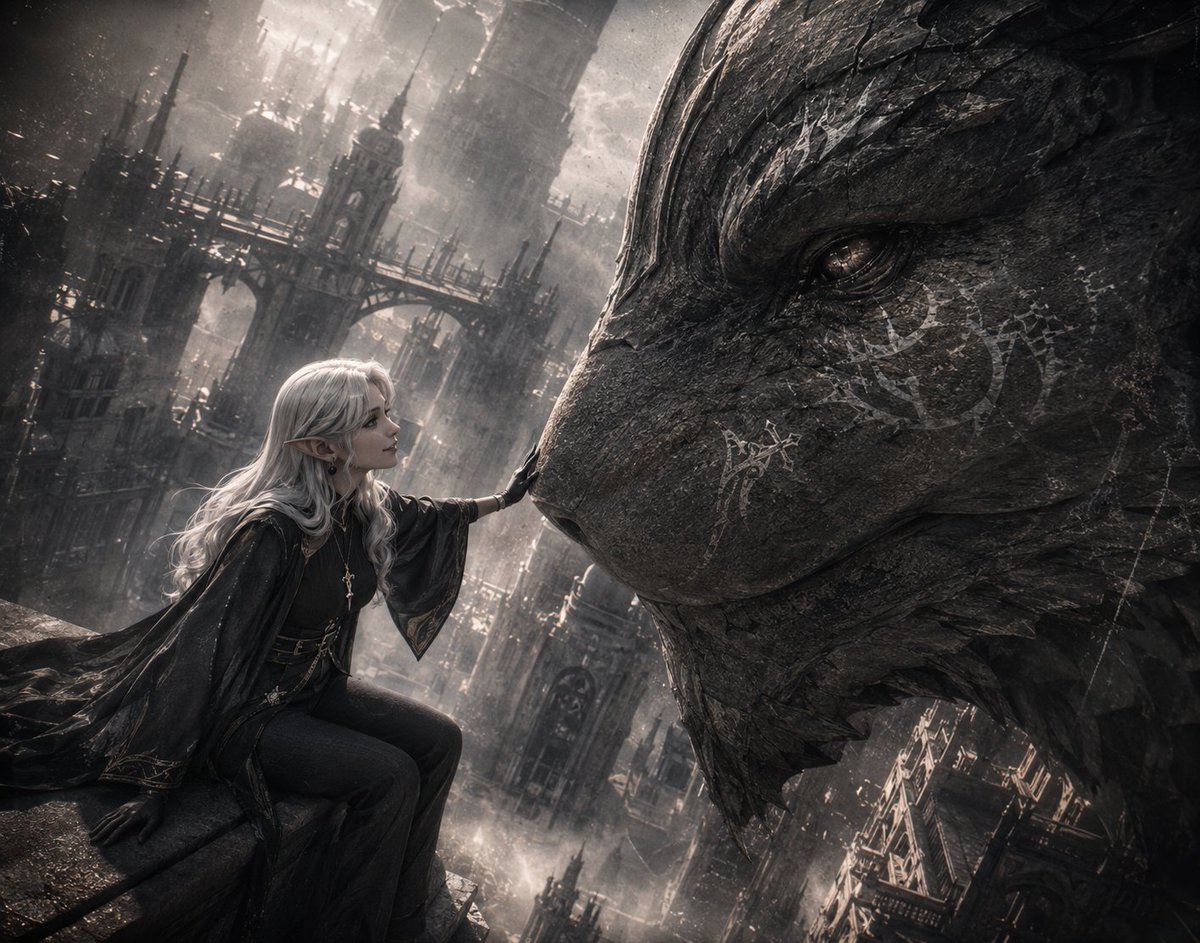
Create a cinematic close-up of the central adult character calmly taming a colossal kaiju-sized beast. The character is seated on the edge of a high rooftop, leaning toward the creature with one hand resting gently against the front of its enormous nose or muzzle. The gesture should communicate trust, calm authority, mutual recognition, and an intimate bond rather than combat or fear.
Kaiju Design
The beast’s immense head dominates much of the composition, looming close to the character and camera. Its scale must feel monumental, with the character appearing small but visually important beside it.
Design the beast as an original creature whose anatomy, textures, materials, markings, armor-like surfaces, ornaments, and symbolic details are influenced by the supplied image’s visual motifs. Do not simply enlarge the supplied character or create an identical duplicate of them. The beast should feel like a separate but aesthetically related entity from the same universe.
Surreal Architecture
Place the scene within a surreal cityscape of impossible rooftops, monumental towers, domes, bridges, arches, suspended structures, distorted perspectives, and dreamlike architecture.
Adapt the architecture to the supplied image’s design language. Repeat recognizable shapes, materials, patterns, emblems, ornamental forms, and symbolic motifs from the supplied image across the buildings and environment without reproducing the original background.
Composition and Camera
Use a dramatic Dutch angle and a strong diagonal composition. Frame the interaction closely enough for the character’s identity and hand-to-beast contact to remain clearly visible, while still communicating the overwhelming scale of the creature and the city below.
Use a subtle tilt-shift or selective-focus effect, with controlled depth of field that keeps the character and the creature’s eye, nose, and facial textures visually legible.
Aspect Ratio
Render the final image in a horizontal 14:11 aspect ratio. Compose specifically for this frame, preserving the cinematic close-up, dramatic Dutch angle, rooftop setting, hand-to-beast contact, surreal architecture, and the kaiju’s monumental scale. Do not crop the character’s head, touching hand, or the essential facial features of the beast.
Lighting and Atmosphere
Illuminate the scene with dramatic god rays cutting through dense volumetric fog, airborne dust, smoke, mist, and drifting particles. Use strong atmospheric depth, cinematic backlighting, soft rim light, deep shadows, and scattered highlights.
Color Treatment
Render the image in a heavily de-saturated, nearly black-and-white palette. The image should read as almost monochrome overall.
If the supplied image contains distinctive hues, reinterpret them only as extremely restrained undertones or faint tonal accents. Do not allow any color to become vivid, saturated, or dominant.
Maintain the supplied image’s tonal mood, contrast character, and visual atmosphere, but translate them into a near-monochrome treatment rather than a full-color palette.
Film Texture and Damage
Render the image with pronounced film grain and the appearance of heavily damaged analog film. Introduce visible grain, surface noise, dust, scratches, abrasion, emulsion wear, distressed texture, subtle streaking, and aged film deterioration across the image.
The damage should feel intentional, cinematic, and atmospheric rather than sloppy or unreadable. Preserve clarity of the character’s identity, the hand-to-beast contact, and the major forms of the scene while giving the image a weathered, archival, battered-film quality.
Mood and Finish
The final image should feel surreal, majestic, intimate, ancient, and slightly eerie. Aim for a highly detailed cinematic fantasy or science-fiction image with tactile materials, atmospheric scale, believable contact between the hand and the creature’s nose, and a strong emotional relationship between the character and beast.
Identity Protection Rules
Preserve identity over generic beautification. Do not redesign the central character into a conventional human, remove non-human anatomy, standardize facial features, lighten or darken skin arbitrarily, change apparent ethnicity, change species, alter gender presentation, expose covered features, remove protective equipment, erase markings, replace prosthetics, simplify cybernetics, or discard identity-defining asymmetry.
Negative Constraints
Do not add extra limbs, fingers, eyes, heads, horns, wings, tails, accessories, or facial features unless they are clearly supported by the supplied image or required by the described creature.
Avoid malformed hands, floating contact, intersecting anatomy, duplicated features, inconsistent scale, misplaced eyes, accidental face exposure, generic costumes, unrelated color schemes, modern everyday city architecture, cheerful lighting, oversaturated colors, cartoon comedy, anime-style faces, cel shading, text, captions, logos, signatures, or watermarks.
@Runya_EithelNar @WarriorMathias @PhoolishLafter @LadyWasabee
🖼️ 参考图(最多 3 张,选填):