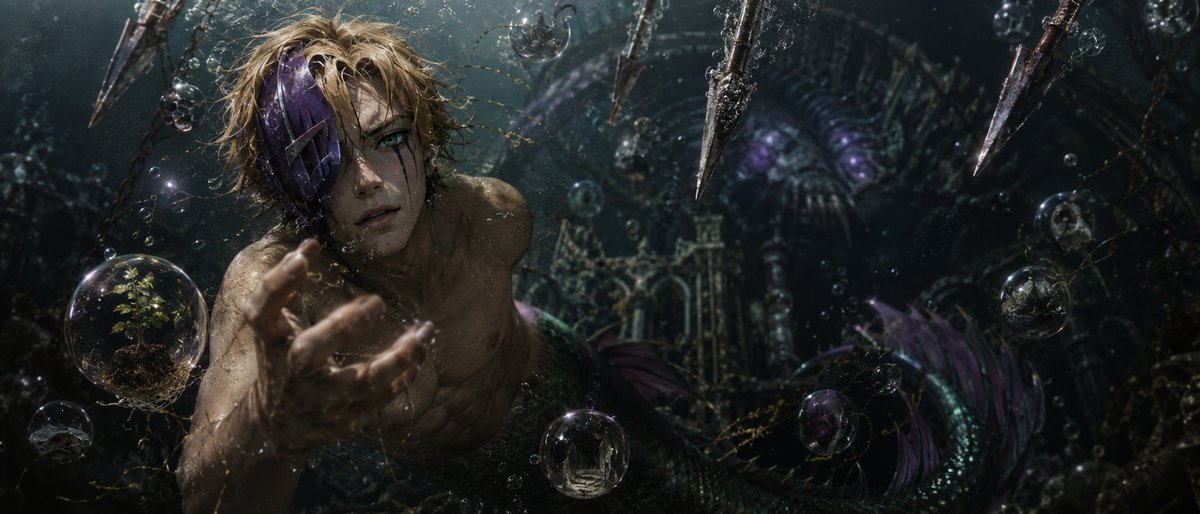
Character Identity
Use the supplied image as the absolute authority for the central character’s identity, apparent age, species if non-human, anatomy, facial structure, body proportions, silhouette, hairstyle or head shape, expression language, distinctive markings, eye details, head design, color palette, materials, and symbolic motifs. Preserve clear recognizability. The character must be unmistakably adult.
Do not copy the supplied image’s pose, outfit, background, lighting, or camera angle. Create a new dark, eerie, surreal underwater horror scene uniquely built around this specific character.
Face and Feature Preservation
If the supplied image has a hidden, masked, covered, cropped, armored, veiled, non-human, plant-covered, or abstracted face, preserve that exact level of facial concealment. Do not invent, reveal, beautify, humanize, or expose a new face.
If only one eye is visible, keep only one eye visible. If no eyes are visible, do not add eyes. Preserve visible eye color, iris structure, pupil shape, sclera color, heterochromia, glow, markings, lashes, makeup, and gaze language.
Preserve all unique scars, tattoos, patterns, armor-like surfaces, prosthetics, cybernetics, scales, symbols, or non-human traits.
Visual Style
The final image must look like a real high-end underwater photograph, not illustration, anime, CGI, fantasy concept art, game cinematic, or 3D render.
Use physically believable underwater optics: murky water volume, suspended silt, plankton, particulate haze, chromatic depth falloff, refractive distortion, underwater lens softness, caustic light ripples, microbubbles, wet highlights, and natural underwater blur.
All skin, masks, scales, seaweed, bubbles, ruins, harpoons, and creature surfaces must have tactile photoreal texture.
Scene Design
Build the entire underwater nightmare from the character’s own visual logic. The ruins, sea growth, tail form, bubble contents, background creature, debris, lighting, and threatening objects should feel derived from the supplied character’s palette, silhouette, materials, symbols, and motifs.
The scene must feel custom-made for this character, not a reusable underwater template.
Composition
Create a cinematic 21:9 close-up underwater portrait with a strong Dutch angle and heavy tilt-shift miniature depth of field.
The character floats in dark water, surrounded by silt, plankton, rotting seaweed, drifting particles, tiny air trails, debris, pressure distortion, and dreamlike aquatic haze.
The mood should be beautiful, desperate, elegant, intimate, unsettling, and otherworldly.
Emotion
The character’s emotion should feel frightened, exhausted, pleading, helpless, and haunted, as if trapped below the surface.
If the face is hidden or unreadable, express this through posture, head angle, body tension, hand position, floating hair or head elements, and surrounding atmosphere without revealing a new face.
Mermaid Anatomy
Give the character an organic mermaid-like lower body integrated into the supplied design.
The transition should feel biological, wet, heavy, eerie, and real: a long aquatic tail, fins, scales, membranes, or surreal marine anatomy inspired by the reference palette and motifs.
It must not look like a costume, swimsuit, detachable tail, decorative mermaid outfit, or fantasy prop.
Lighting
Lighting must feel genuinely submerged: dim filtered light from above, rippling caustics, murky green-blue darkness, uneven refraction, low visibility, drifting shadows, and deep falloff into aquatic gloom.
Avoid clean studio or fashion lighting.
Feminine Upper-Body Coverage
For clearly adult feminine characters only, create an upper-body outfit coverage from naturally draped seaweed.
It should be tasteful, organic, irregular, and underwater-formed, not glamorous or costume-like.
The seaweed must not look like a structured top, bikini, bra, bandeau, corset, halter, tailored garment, or styled fashion piece. It should look like loose ocean growth that has drifted, tangled, and settled naturally through current pressure, bubbles, shadow, refraction, and debris.
The seaweed should be asymmetrical, imperfect, and naturally draped, clinging in some areas and floating away in others. Use photorealistic details: translucent wet edges, torn fronds, veins, algae stains, trapped microbubbles, slick dark surfaces, frayed strands, uneven thickness, and believable underwater drag.
Masculine Upper-Body Direction
For clearly adult male or masculine characters, keep the upper body bare and topless with no shirt, armor, wraps, seaweed top, swimsuit styling, or wearable upper-body garment.
The presentation must remain non-explicit, cinematic, and character-focused, using underwater lighting, shadow, bubbles, drifting plant matter, body angle, murk, and framing as needed for tasteful composition.
Non-Feminine or Incompatible Characters
For non-feminine, creature-like, masked, armored, or anatomy-incompatible characters, do not add a seaweed top.
Use only natural occlusion from drifting plant matter, bubbles, shadow, murk, body angle, or framing.
Ceremonial Bubbles
Large translucent bubbles orbit around the character’s upper body and surrounding water in a slow ceremonial spiral.
Some contain impossible photoreal miniature worlds: strange beings, alien landscapes, ghostly figures, submerged ruins, storms, or horror tableaux.
One bubble must contain dark soil and a small sapling, with tiny roots pressing against the inner surface and a few hair-thin roots seeming to leak into the water.
Another bubble must contain a small identity-relevant object, symbol, accessory, ornament, motif, or material detail derived directly from the supplied image, preserved like a relic inside curved glassy water.
Threat From Above
Above the character, giant ancient harpoons descend through the water from outside the frame, trailing bubbles, torn currents, ropes, chains, rust, barnacles, scratches, and debris.
They imply danger from above without striking the character.
Architecture and Ruins
Behind the character, show enormous drowned cathedral ribs, broken arches, fossil-like columns, or ribbed architectural remains fading into darkness.
These structures should feel almost like natural rock or the skeletal remains of an ancient leviathan, adding sacred scale without overpowering the central figure.
Background Creature
In the far background, place a massive partially hidden sea creature: a colossal photoreal silhouette with faint bioluminescent markings, hints of tentacles, fins, spines, ridges, jaws, barnacles, rough skin, scales, slick tissue, or impossible anatomy fading into the gloom.
Its design should echo the supplied image’s palette and motifs while remaining secondary to the central character.
Focus and Depth
Sharpest focus should stay on the identity-defining head area, upper body, natural seaweed draping when applicable, topless masculine upper body when applicable, organic mermaid-like lower body, and nearest bubbles, with heavy tilt-shift falloff into blurred surreal darkness.
Final Result
Final result: photorealistic, cinematic, haunting, intimate, submerged, desperate, murky, sacred, tasteful, non-explicit, and impossibly surreal.
Avoid
Avoid changed identity, revealed hidden face, invented facial features, removed masks or head coverings, changed eye state, missing markings, lingerie styling, swimsuit styling, erotic posing, structured seaweed top, bra-like seaweed, bikini-like seaweed, bandeau-like seaweed, tailored seaweed garment, seaweed top on male or masculine characters, shirts or upper-body garments on male or masculine characters, cute fantasy mermaid design, costume tail, clean studio lighting, aquarium clarity, ordinary ocean scene, polished CGI, painterly style, anime style, waxy skin, airbrushed skin, graphic injury, gore, harpoons striking the character, extra limbs, broken hands, warped anatomy, or a background creature that dominates the central character.
🖼️ 参考图(最多 3 张,选填):