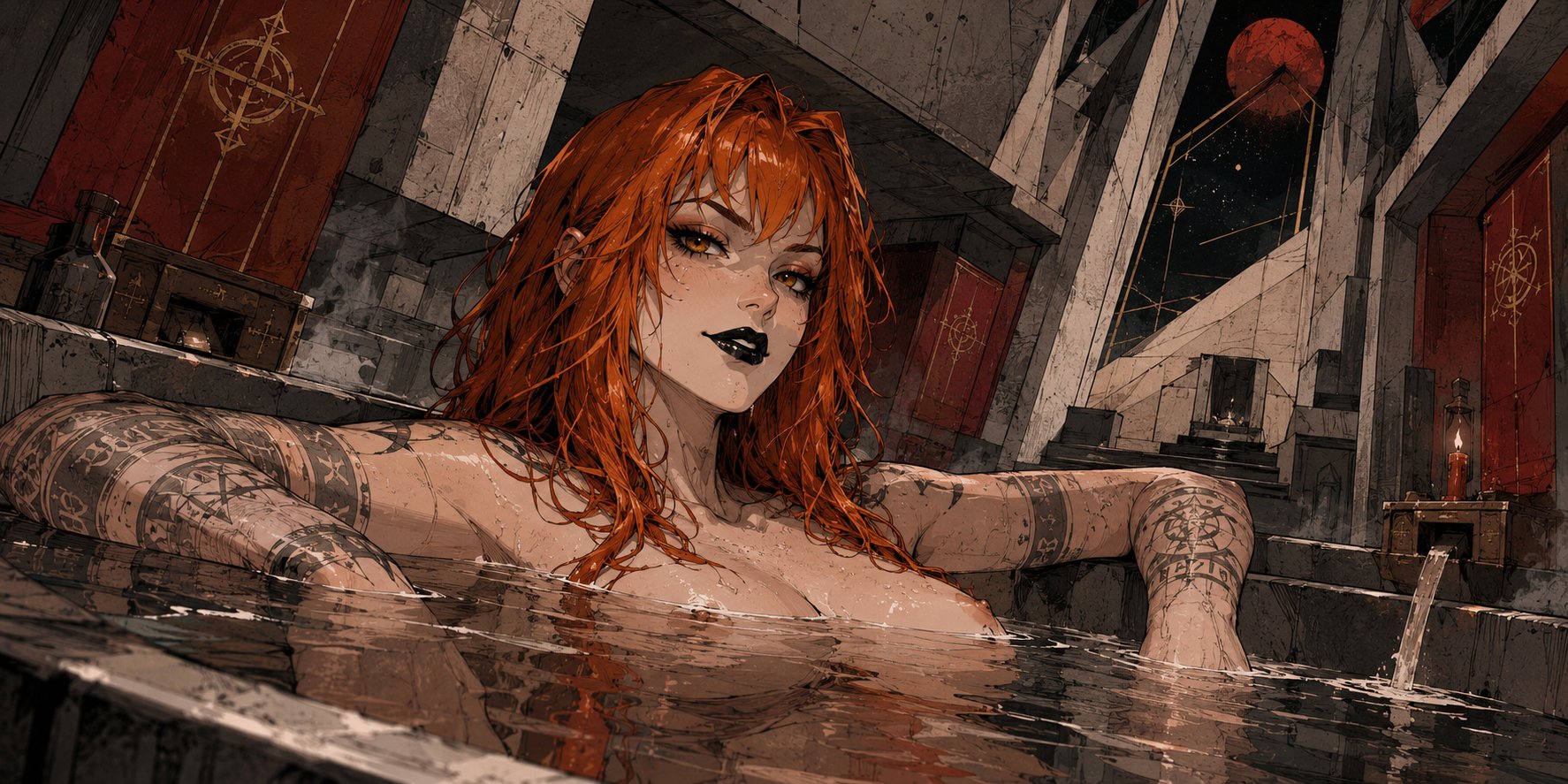
Use the supplied image as the absolute visual authority for the character's identity. The final image must immediately read as the exact same unmistakably adult character, reinterpreted in a completely new cinematic bathtub scene.
Preserve with very high fidelity the character's species, adult age and gender presentation, facial/head structure, anatomy, proportions, silhouette, hairstyle or equivalent head structure, expression language, coloration, markings, scars, tattoos, prosthetics, cybernetics, masks, helmets, visors, horns, ears, tails, wings, fins, claws, jewelry, insignia, symbolic motifs, and all other identity-defining features.
Do not copy the source pose, camera angle, background, composition, or clothing design.
The face or equivalent identity-defining head region must remain the primary focal point and retain the character's exact recognizable geometry. Translate the reference into semi-realistic graphic-novel anatomy without beautifying, simplifying, or replacing the character with a generic attractive face.
Absolutely avoid anime, manga, waifu, doll, chibi, game-avatar, or generic model facial conventions. No oversized anime eyes, tiny stylized nose or mouth, pointed V-shaped chin, manga eyelashes, exaggerated youthful proportions, artificial symmetry, or generic beauty-face conversion.
Do not normalize unusual anatomy, asymmetry, markings, scars, masks, prosthetics, cybernetics, or non-human structures. Keep concealed facial features concealed. Preserve visible eyes in their distinctive shape, scale, placement, color, markings, glow, and anatomy. Keep the expression calm, composed, neutral, or subtly introspective.
Render as a hand-inked sci-fi graphic novel illustration with a European bande dessinée aesthetic. Use fine scratchy pen lines, loose architectural drafting marks, confident contour work, selective cross-hatching, flat cel-shaded color shapes, muted retro-futurist colors, weathered print texture, slight ink irregularity, and tactile analog reproduction artifacts.
The anatomy should remain semi-realistic and structurally convincing, with strong perspective and extreme but controlled foreshortening. Avoid glossy digital painting, smooth 3D rendering, photoreal skin, airbrushed gradients, anime rendering, painterly fantasy art, or polished game-concept aesthetics.
Preserve the exact hairstyle or equivalent head structure, including color, texture, length, silhouette, hairline, and accessories. Dampness may alter strand grouping and weight but must not redesign it.
The source clothing must have no influence on the new scene. Do not reproduce its silhouette, neckline, straps, sleeves, patterns, layering, hardware, or color blocking. Identity-critical non-garment elements such as masks, helmets, prosthetics, cybernetics, crowns, jewelry, insignia, or integrated structures may remain.
Create a premium graphic-novel close-up of the character reclining naturally in a luxurious bathtub filled with warm, semi-opaque but still translucent water.
The bathtub, architecture, fixtures, and environment must be completely new while reinterpreting the character's palette, geometry, materials, symbols, motifs, and cultural or technological language.
Build the surroundings as surreal brutalist sci-fi architecture: monumental geometric masses, sculptural concrete or metal forms, severe structural planes, unusual recessed fixtures, impossible-but-coherent spatial relationships, and sparse architectural detailing. Use loose drafting lines, construction marks, perspective guides, and hand-drawn imperfections to make the environment feel designed directly on the page.
The setting should feel like an architectural extension of the character's world, not a generic hotel bathroom, spa, fantasy palace, or standard cyberpunk interior.
Raise the waterline slightly so it sits high across the upper chest, just below the collarbones. Only the head, neck, shoulders, collarbones, and a minimal amount of upper cleavage may remain above water. Most of the chest and the entire lower torso must remain submerged.
Depict the water with believable depth, surface tension, ripples, reflections, refraction, waterline distortion, and submerged tonal falloff, simplified through clear ink lines and flat cel-shaded value shapes rather than photoreal rendering.
Maintain tasteful editorial coverage through the high waterline, submersion, tub geometry, perspective, reflection, refraction, framing, and depth of field cues. Do not lower the waterline for pose or body visibility.
No towels, foam, bubbles, flowers, bath bombs, opaque milky water, or decorative coverage props.
Include only a few faint, delicate wisps of steam, drawn sparingly with broken linework and translucent flat shapes. Never let steam become dense fog or obscure the character.
Adapt the pose to the character's actual anatomy. Preserve wings, tails, horns, ears, fins, extra limbs, prosthetics, mechanical appendages, or armor-like anatomy without deleting, compressing, or unnaturally folding them.
The character should recline naturally with believable weight, buoyancy, joint articulation, and contact with the tub. Arms or equivalent appendages may rest along the tub edges. Keep the posture calm, refined, self-possessed, and editorial rather than theatrical or body-focused.
Use dramatic graphic-novel lighting derived from the reference palette, expressed through hard-edged cel-shaded value groups, sparse reflected color, selective rim light, deep inked shadow shapes, and restrained highlights.
Preserve distinctive cool, lunar, alien, magical, industrial, neon, bioluminescent, or emissive lighting language from the character rather than replacing it with generic warm spa lighting.
Keep the background restrained and atmospheric, with only a few softly simplified architectural, technological, celestial, biomechanical, industrial, organic, or symbolic details derived from the source.
Aspect ratio: 18:9 horizontal.
Place the viewpoint extremely close to the bathtub rim and slightly above water level. Use an intimate editorial composition with a pronounced Dutch angle, dramatic perspective, and extreme but controlled foreshortening.
Frame the face/head, shoulders or anatomical equivalents, upper silhouette, arms or equivalent appendages where appropriate, surrounding water, and enough structural anatomy to preserve recognizability.
Keep identity, not body display, as the visual center.
The face/head region must receive the sharpest, finest ink detail. Let the foreground rim, nearest hand or appendage, water surface, and distant architecture become progressively looser, scratchier, and less detailed to create illustrated depth.
Use fine line-weight variation, selective cross-hatching, flat shadow blocks, muted retro colors, aged paper or weathered print texture, slight registration imperfections, restrained halftone or ink wear, and expressive drafting marks.
Do not alter or omit identity-defining anatomy, coloration, markings, scars, tattoos, eyes, prosthetics, cybernetics, horns, ears, wings, tails, masks, helmets, visors, jewelry, insignia, or distinctive appendages.
Avoid anime or manga faces, doll faces, generic model beauty, hoods, glossy digital painting, photoreal rendering, smooth CGI, painterly fantasy aesthetics, source-costume adaptation, generic spa décor, malformed or duplicated limbs, missing appendages, inconsistent markings, impossible water behavior, low waterlines, excessive exposed torso, dense steam, or voyeuristic framing.
The finished image should feel like a hand-inked European sci-fi graphic novel plate: semi-realistic, aggressively perspectival, architecturally surreal, tactile and imperfect, with scratchy linework, flat cel-shaded colors, muted retro tones, weathered print texture, and unmistakably faithful character identity.
🖼️ 参考图(最多 3 张,选填):