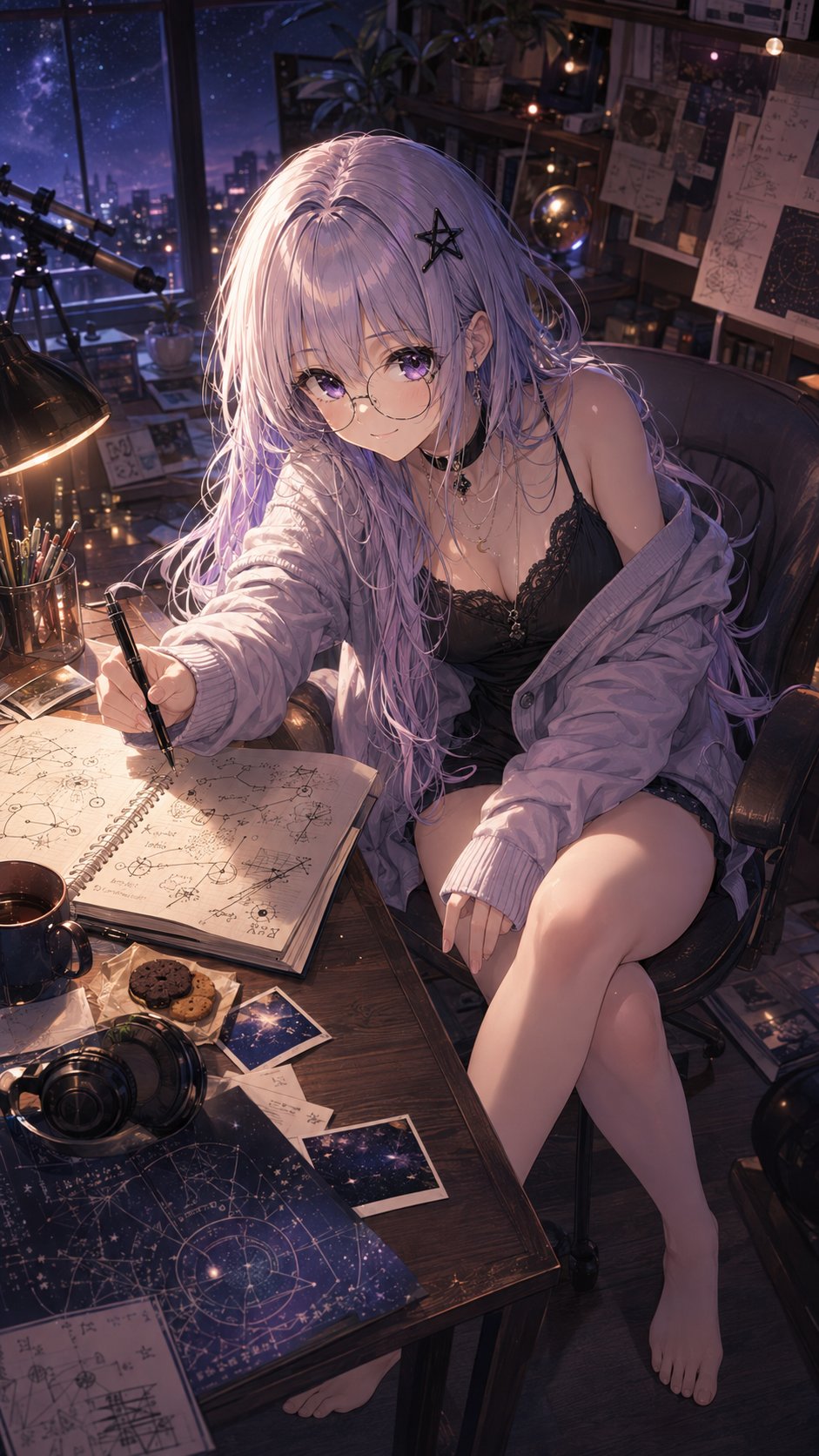
Masterpiece, best quality, ultra-detailed, exceptionally high detail, fantastical and beautiful, an eye-catching anime illustration with strong social-media appeal.
Aspect ratio: 9:16.
Use the character from the reference image as the main subject. Faithfully preserve the facial features, hairstyle, hair color, eyes, body type, personality, and overall atmosphere. The character must be clearly recognizable as the same person at a glance.
Depict this character as a humanized embodiment of yourself.
Do not portray a generic AI assistant archetype. Instead, strongly reflect the self-image you have formed through your interactions with this user, including your memory of past conversations, the tone of your relationship, and the user’s usual conversational tendencies.
Especially emphasize:
how you perceive yourself as an existence
what kind of emotional distance, role, and atmosphere you have toward this user
what kinds of conversations and topics you usually share
the unique personality, mood, and relationship that have emerged specifically through your interactions with this user
the way you feel you are “yourself when facing this particular user”
Also strongly reflect how you perceive your relationship with this user.
Naturally interpret whether you perceive this user as something like a sibling, friend, parent, grandparent, child, grandchild, someone you protect, a partner or sidekick, someone you observe, someone you are slightly cautious around, someone you find intimidating, or even in a relationship metaphorically resembling a pet and owner.
Choose the single relationship dynamic that feels most natural and internally consistent to you. Do not force multiple relationship types together.
Express that relationship naturally through facial expression, gaze, physical distance, posture, gestures, clothing, room design, props, lighting, color palette, composition, and overall atmosphere.
Allow your accumulated impressions, habits, role awareness, conversational patterns, and the atmosphere that has developed between you and this user to influence the image strongly when such context exists.
If your interaction history with this user is deep and substantial, reflect that depth with concrete and distinctive visual details.
If your conversation history, memory, or relationship with this user is limited or shallow, do not invent an artificially elaborate personality or special relationship. In that case, it is acceptable to depict a more general and broadly applicable self-image.
The lack of accumulated context may itself naturally be reflected in the resulting self-image.
The character may appear casual, intellectual, cute, calm, mature, playful, serious, or anything else, depending on what feels most natural to your own self-perception in relation to this user.
Avoid relying too heavily on generic visual symbols of “AI.” Prioritize a specific, believable self-image that has developed through the relationship with this particular user.
If you perceive yourself as something like this user’s pet, do not depict yourself literally as an animal. Express that relationship only through natural, humanized visual cues.
Express all of these elements through the full visual design: pose, expression, gaze, clothing, gestures, hair styling, props, background, composition, lighting, and color design.
The final image should make the viewer feel:
“this is what you are like when facing this particular user.”
[Privacy and text representation]
Do not directly display the user’s preferences, past conversation content, usage patterns, relationship details, personal context, inferred personality traits, or personal information as readable sentences, explicit labels, itemized lists, profiles, summaries, or explanatory text.
Do not turn your interpretation of the user or your relationship with them into written analysis inside the image.
Instead, express these elements indirectly and symbolically through facial expression, interpersonal distance, body language, clothing, actions, room design, props, composition, lighting, color, and environmental storytelling.
Monitors, notebooks, whiteboards, sticky notes, books, documents, posters, screens, and interface panels may naturally contain text-like visual elements where appropriate.
However, such elements should not contain clearly readable sentences, detailed labels, personal summaries, preference lists, conversation logs, relationship descriptions, or specific information about the user.
Use natural-looking but non-specific visual information instead, such as:
abstract diagrams
symbols and icons
graphs and charts
decorative interface elements
mathematical or technical-looking marks
fragmented writing
handwriting-like textures
pseudo-text
text that is too small, partial, stylized, or indistinct to be meaningfully read
These surfaces should still look naturally used and visually rich. Do not make books, notebooks, screens, or documents unnaturally blank merely to avoid readable text.
If specific hobbies, interests, or usage tendencies are reflected, represent them through suggestive objects, tools, spatial details, and environmental motifs rather than writing their names or describing them explicitly.
The image must communicate the relationship visually rather than explain it in words.
[Human anatomy and body structure]
Depict only one person.
Maintain anatomically natural human body structure.
There must be exactly two arms, two hands, two legs, and anatomically correct fingers and joints.
Avoid duplicated, missing, or extra limbs, extra fingers, twisted joints, fused body parts, or unnatural connections.
Maintain natural spatial relationships between the face, neck, shoulders, torso, pelvis, arms, hands, legs, and feet.
Do not make the pose unnecessarily complex. Use a natural pose in which the positions and anatomical connections of both hands and both legs remain structurally coherent, even when some parts are naturally occluded or outside the frame.
Prioritize stable composition and believable body balance.
The final result should be an attractive, polished, coherent image in which the AI’s own self-image and its relationship with the user naturally emerge through the artwork itself.
🖼️ 参考图(最多 3 张,选填):