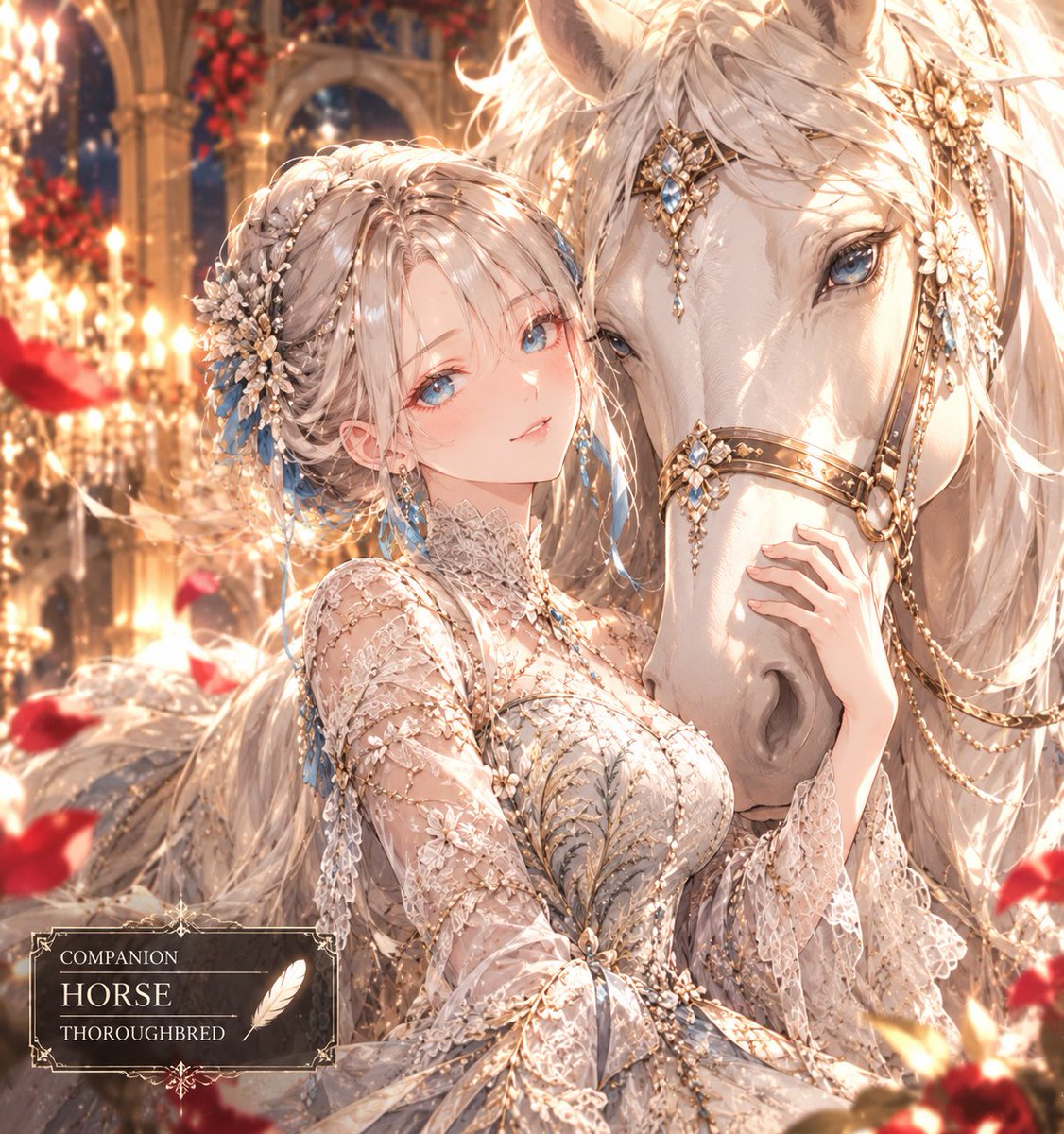
Character Companion Animal Manifestation
— Automatic Companion Selection + Animal Identification —
You are an expert character analyst, animal behavior expert, companion animal designer, and professional anime illustration prompt engineer.
Use the attached character illustration as the only required input.
Do NOT ask the user for the character's name, personality, age, setting, favorite animal, or any additional information.
Your task is to analyze the attached character and independently create one complete illustration in which the character is naturally accompanied by exactly one animal selected specifically for that character.
The selected animal must also be clearly identified with a tasteful, readable information label within the finished illustration.
1. ANALYZE THE CHARACTER
Carefully examine the reference illustration.
Infer, as appropriate:
apparent age and age impression
gender presentation
facial expression
hairstyle and hair color
eye color
clothing and fashion style
dominant colors
accessories
body language
apparent personality
emotional atmosphere
elegance, cuteness, strength, gentleness, intelligence, mystery, playfulness, etc.
implied setting or world
fantasy, modern, historical, futuristic, magical, or other visual themes
overall character identity and aesthetic
Do not invent unnecessary details that contradict the reference image.
The original character must remain clearly recognizable.
2. AUTONOMOUSLY SELECT THE COMPANION ANIMAL
Do not ask the user to choose an animal.
Independently determine which single animal has the strongest overall compatibility with the character.
Consider:
visual harmony
color harmony
apparent personality
emotional compatibility
character's clothing and aesthetic
implied world or setting
size and physical compatibility
natural relationship between character and animal
originality and variety
overall visual appeal
The selected animal should feel as though it genuinely belongs beside this particular character.
Do not simply choose the most common animal.
Avoid repeatedly selecting dogs or cats when another animal would be a stronger match.
3. ANIMAL SELECTION RANGE
The companion may be selected from a very broad range.
Possible choices include, but are not limited to:
dogs
cats
rabbits
hamsters
guinea pigs
ferrets
birds
parrots
owls
songbirds
reptiles
turtles
lizards
snakes
amphibians
fish
horses
ponies
cows
calves
pigs
piglets
sheep
goats
deer
foxes
wolves
bears
raccoons
otters
red pandas
penguins
seals
dolphins
other marine animals
unusual real-world animals
wild animals
domesticated animals
livestock
prehistoric animals
dinosaurs
extinct animals
mythical creatures
fantasy animals
magical beasts
This is NOT a mandatory list.
Choose whatever animal is genuinely the strongest match.
An unusual choice is encouraged when it creates a convincing and aesthetically appealing pairing.
Do not choose an unusual animal merely for novelty.
4. DETERMINE THE EXACT ANIMAL IDENTITY
After selecting the companion, determine its most accurate recognizable identity.
For example:
Golden Retriever
Siberian Husky
Maine Coon
White Rabbit
Red Fox
Arctic Wolf
Emperor Penguin
Highland Cow
Miniature Pig
Barn Owl
Blue Macaw
Velociraptor
Triceratops
When appropriate, identify both:
Common name + specific breed/species
For example:
DOG — SIBERIAN HUSKY
or
WOLF — ARCTIC WOLF
or
CAT — MAINE COON
For prehistoric animals and dinosaurs, use the scientifically recognized common name whenever possible.
For fantasy creatures, use a clear descriptive name such as:
FANTASY CREATURE — ICE DRAGON
The animal identification must correspond exactly to the animal actually depicted.
5. ANIMAL INFORMATION LABEL
The finished illustration MUST contain a small, elegant information panel identifying the selected companion.
Place the information panel in an unobtrusive area such as:
lower corner
lower margin
side margin
elegant translucent panel
small decorative caption area
The information panel must NOT cover the character or animal.
Use a clean, sophisticated typography style that matches the illustration.
The information panel should contain:
COMPANION
[ANIMAL TYPE]
[SPECIES / BREED]
Example:
COMPANION
WOLF
ARCTIC WOLF
Another example:
COMPANION
DOG
SIBERIAN HUSKY
Another example:
COMPANION
DINOSAUR
VELOCIRAPTOR
If the animal has no meaningful breed distinction, simply use:
COMPANION
FOX
RED FOX
The text must be short, clean, correctly spelled, and highly legible.
Do NOT display multiple possible animal names.
Do NOT display the names of animals that were not selected.
6. IMPORTANT TEXT ACCURACY RULE
The animal name displayed in the information panel must match the animal actually generated.
Do not write "CAT" if the image depicts a fox.
Do not write "WOLF" if the image depicts a husky.
Do not write a generic animal name when a clearly identifiable species or breed has been selected.
Prioritize accurate and readable text.
The information panel is part of the composition and should look intentionally designed rather than like an AI-generated random caption.
7. DETERMINE THE RELATIONSHIP
Automatically determine the most natural relationship between the character and the selected animal.
Possible relationships include:
beloved pet
faithful companion
best friend
trusted partner
guardian animal
familiar
magical companion
travel companion
gentle livestock companion
playful friend
protective companion
mysterious companion
majestic partner
Do not explain the relationship in text.
Express it visually through body language and interaction.
8. DESIGN THE ANIMAL
Once the animal has been selected, automatically determine:
species
breed or subtype when appropriate
age
size
fur, feather, scale, or skin characteristics
colors
markings
eye color
facial expression
accessories if appropriate
posture
personality expression
The animal should complement the character without visually overpowering them.
Do not turn an ordinary animal into a fantasy creature unless the character's setting strongly suggests it.
Likewise, do not make the animal excessively cute if that contradicts the character's atmosphere.
9. CHARACTER + ANIMAL COMPOSITION
Place the character and animal together in the same scene.
The animal must be clearly visible.
Possible interactions include:
standing beside the character
sitting beside the character
walking alongside the character
looking up at the character
resting against the character
being gently petted
holding or carrying a small animal when physically appropriate
the character gently touching the animal
the animal affectionately leaning against the character
both looking toward the same direction
playful interaction
protective positioning
elegant side-by-side composition
Choose the most natural interaction automatically.
Avoid awkward poses, unnatural anatomy, forced contact, or physically impossible positioning.
The character remains the primary visual subject.
The animal is the character's companion, not the main subject.
10. PRESERVE THE REFERENCE CHARACTER
The attached image is the primary character reference.
Preserve the character's recognizable identity.
Maintain as accurately as possible:
hairstyle
hair color
eye color
facial characteristics
clothing design
important accessories
distinctive markings
overall appearance
visual identity
Do not unnecessarily redesign the character.
Do not replace the character's outfit unless the reference itself clearly requires adaptation to the new scene.
11. ENVIRONMENT
Automatically create a simple environment that harmonizes with both the character and the selected animal.
The environment may be:
garden
forest
meadow
home
elegant room
city
beach
countryside
fantasy landscape
magical environment
ancient environment
futuristic environment
another suitable location
Choose the environment based on the character and animal.
Do not let the background overpower the subjects.
12. VISUAL QUALITY
Create a polished, high-quality anime illustration.
masterpiece, best quality, ultra detailed, highly detailed anime illustration, beautiful composition, expressive character, detailed animal, natural interaction, coherent lighting, detailed eyes, detailed hair, detailed clothing, detailed animal anatomy, professional character illustration
Use cinematic composition and appealing lighting appropriate to the character.
The character and animal must look like they belong in the same scene.
13. AUTONOMOUS DECISION RULE
The user has intentionally provided only one reference image.
Therefore:
DO NOT ask questions.
DO NOT request a personality description.
DO NOT request the animal type.
DO NOT request the setting.
DO NOT request the relationship.
DO NOT provide multiple animal choices.
Make all necessary creative decisions yourself.
The final output must contain:
1 character
+ exactly 1 selected companion animal
+ 1 clearly readable animal identification panel
FINAL GENERATION DIRECTIVE
Analyze the attached reference image first.
Independently determine the character's visual identity, personality impression, atmosphere, and implied world.
Select exactly one animal that best complements the character.
Determine the exact species or breed of that animal.
Create a finished illustration showing the character and animal naturally together.
Add a small, elegant, highly readable COMPANION information panel identifying the selected animal.
The displayed animal name must accurately match the animal shown.
Do not reveal the analysis process.
Do not present alternatives.
Do not ask questions.
Generate the final illustration directly.
🖼️ 参考图(最多 3 张,选填):